

“Night of the Hunter” is a chilling noir thriller featuring Robert Mitchum in the iconic role of a psychopathic, serial-killing preacher, arguably his best performance ever. It is the only movie directed by the legendary actor Charles Laughton.
The movie is a thrill ride from the beginning to ‘almost’ its ending (more on that later). The plot is laced with nursery rhyme references, poems, fairy tales, and scripture, sometimes just as they are and sometimes implicitly referenced, and sometimes with metaphors for the plot’s narrative. Laughton himself said of the movie, “It’s really a nightmarish sort of Mother Goose tale we are telling.”
The movie opens with a middle-aged woman (later revealed as Rachel Cooper, a caretaker of orphaned children) delivering a sermon to the children. “Beware of false prophets, who come to you in sheep’s clothing,” she says, which will turn out to be an ominous warning of things to come.
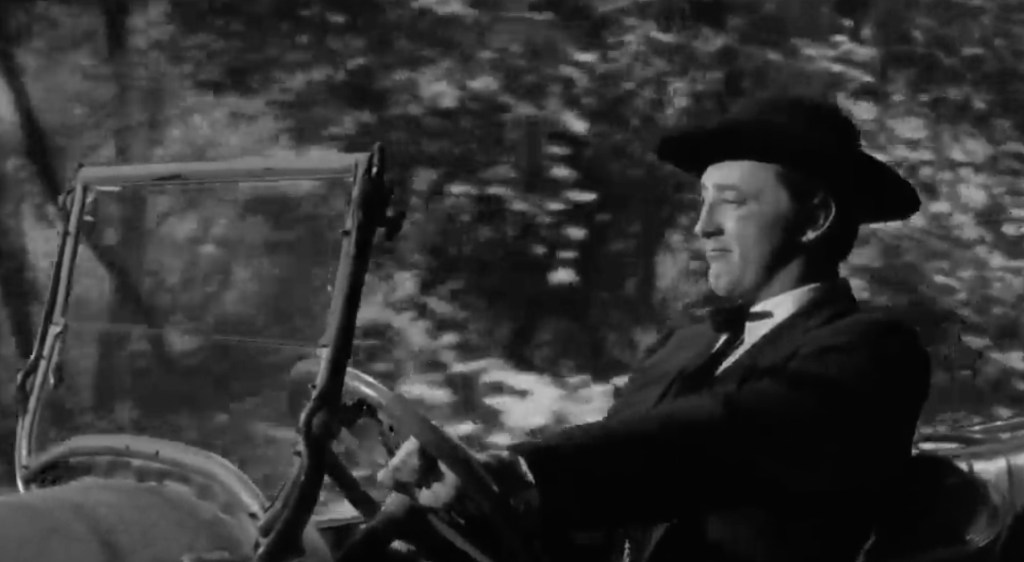
The scene changes to a field where a group of young kids discover the corpse of a woman. The scene changes again, and we see a man in a hat and dressed in clergy clothes riding a convertible, asking God if he will again find a rich widow. He then hatefully curses “Things with laces.”
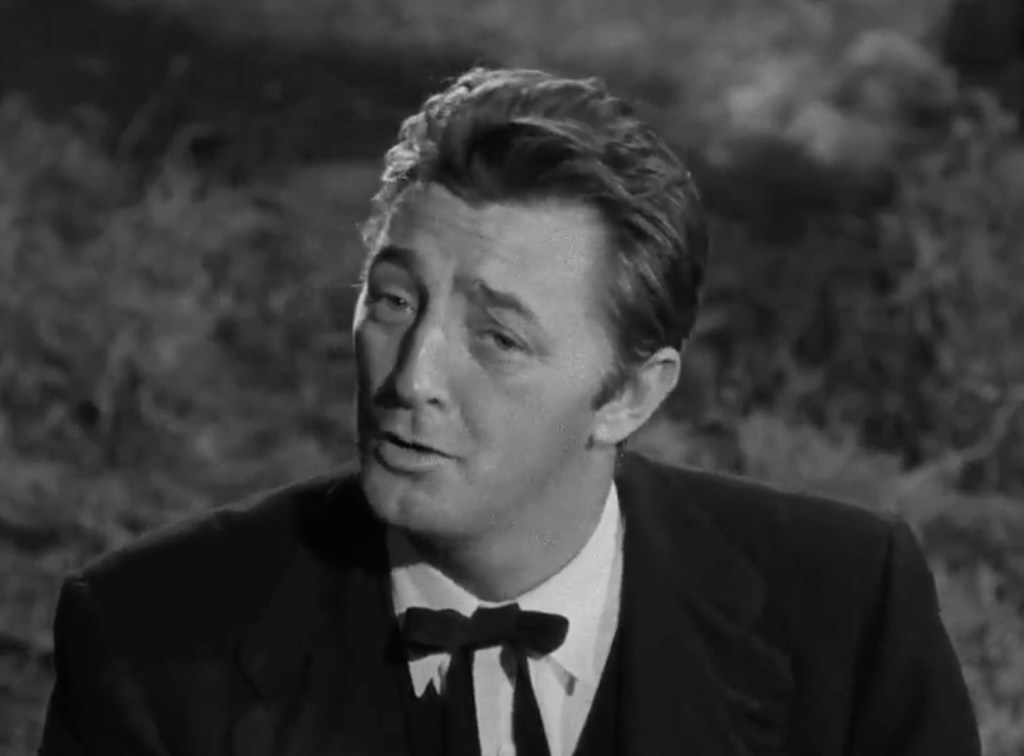
The man is revealed to be Reverend Harry Powell (Robert Mitchum) and is next seen watching a cabaret at a theater. Cops enter the theater, and Powell is arrested on the spot for stealing an automobile and ordered to spend 30 days in prison.
Meanwhile, a young boy and his little sister are accosted by their father, Ben Harper (Peter Graves), a man on the lam. Harper has murdered two people and hides a stolen loot of $10,000 in the presence of his young son, John. He asks his son to swear not to reveal the location of this loot to anyone and to take care of his little sister, Pearl.
Just then, his wife, Willa (Shirley Winters), appears on the scene, and so does the law. Harper is arrested, given the death penalty, and thrown into prison. Harper ends up sharing a cell with Powell for the rest of his few days until he is to hang for his crimes.
It is here that we get a glimpse of Powell’s hands. The word “Love” is tattooed on the fingers of one hand, and the fingers of the other have the word “Hate” tattooed on them.
Despite Powell’s best efforts to extract the location of Harper’s loot, the latter takes this secret with him to his grave. Powell, now obsessed with getting his hands on the money, travels to Harper’s hometown.
Laughton now places an obvious metaphor for what happens in the past. John and Pearl, the late Harper’s children, are seen with some boys who sing a nursery rhyme:
Hing hang hung,
See what the hangman done
Hing hang hung
See the robber swing
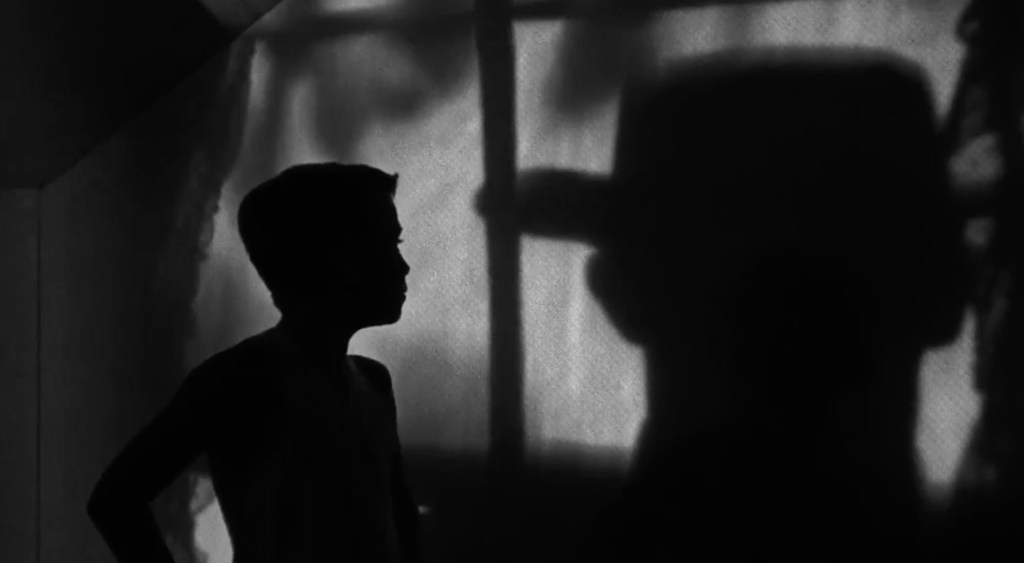
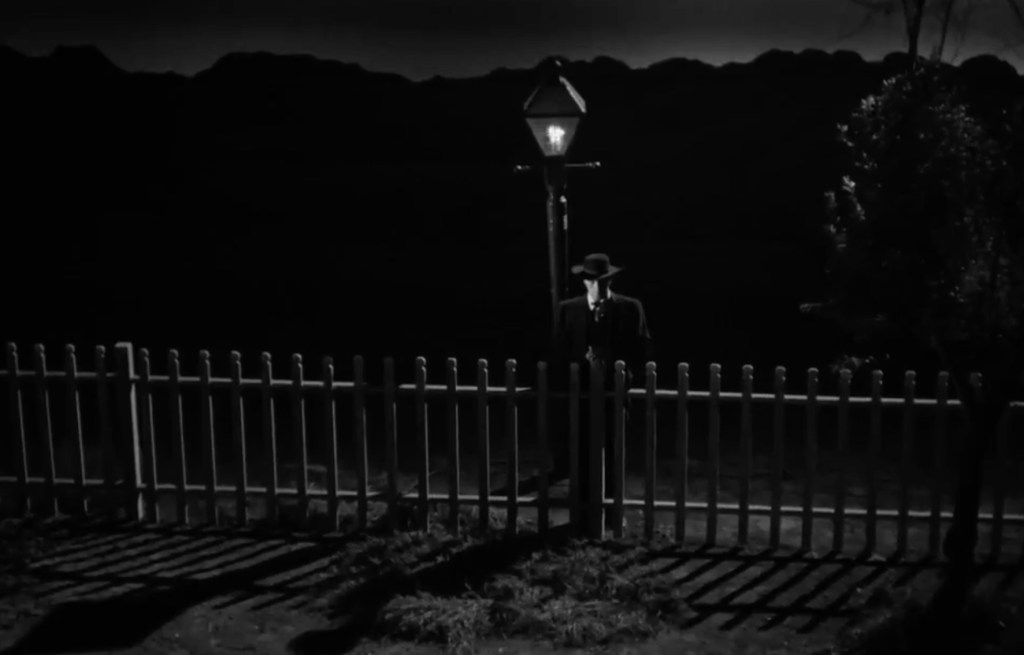
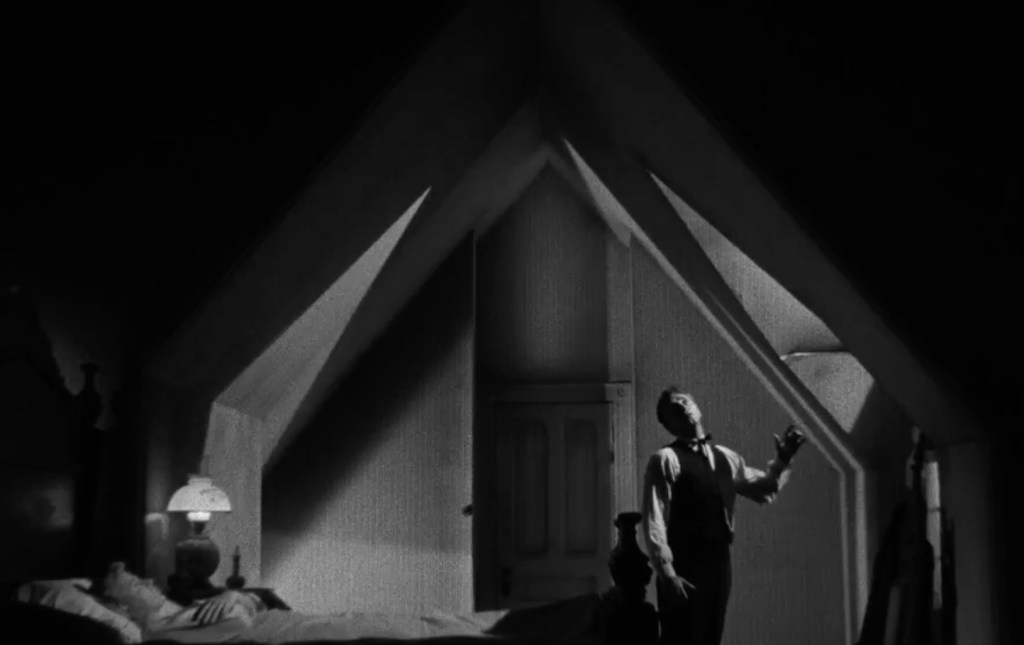
Laughton next throws in a scare at this stage. One night, John is seen telling young Pearl a made-up story about buried treasure to put her to sleep when a frightening silhouette of a man suddenly appears on the wall. As John pacifies his terrified sister, the silhouette is revealed to belong to Powell, who is seen outside in the dark, ‘casing’ the joint.
Powell charms his way into the community and marries Harper’s widow, Willa. Soon he shows his true colors, mistreating Willa and terrorizing John to reveal the location of the hidden loot.
Powell refuses to consummate the marriage with Willa. Soon Willa overhears Powell threatening not only John but even the young Pearl. Willa is despondent and withdraws into herself when Powell stabs her to death. He ties her corpse to a car that he pushes into a river that runs across the town.
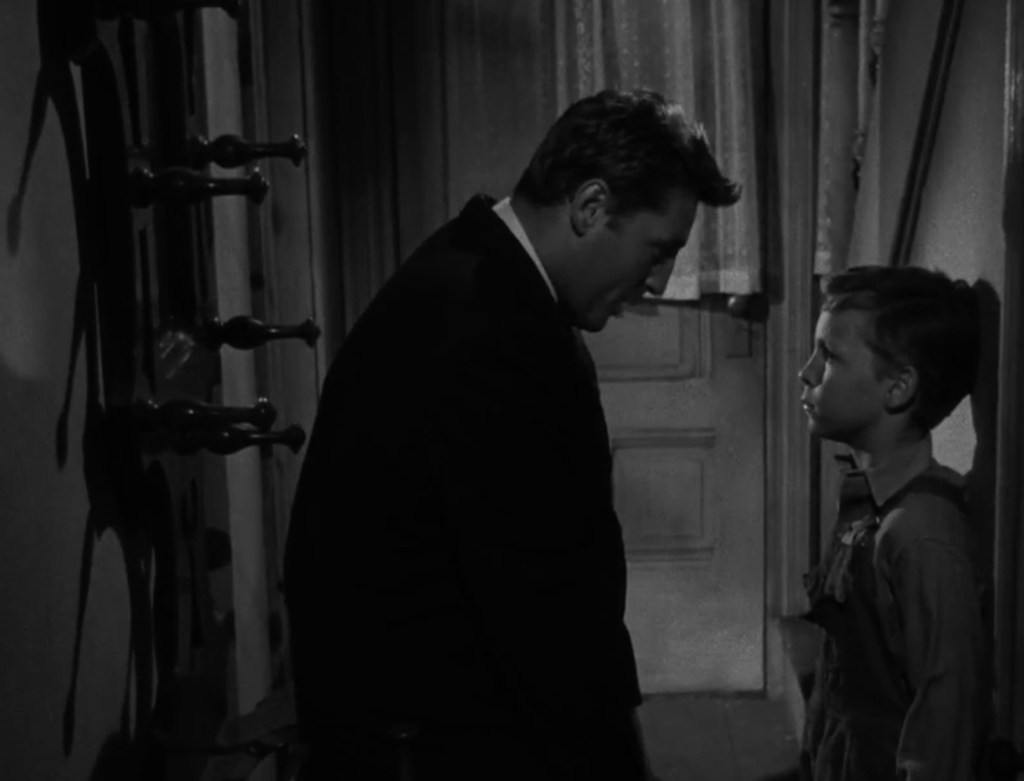
He sells the narrative that Willa abandoned him and the children and skipped town ‘for a life of sin’ to Willa’s friends. “Children!” “Children!” he beckons them, a chilling moment for the children and the audience as well. With no restriction between him and the children, Powell terrorizes John and Pearl, first over dinner and then by taking them to the basement.
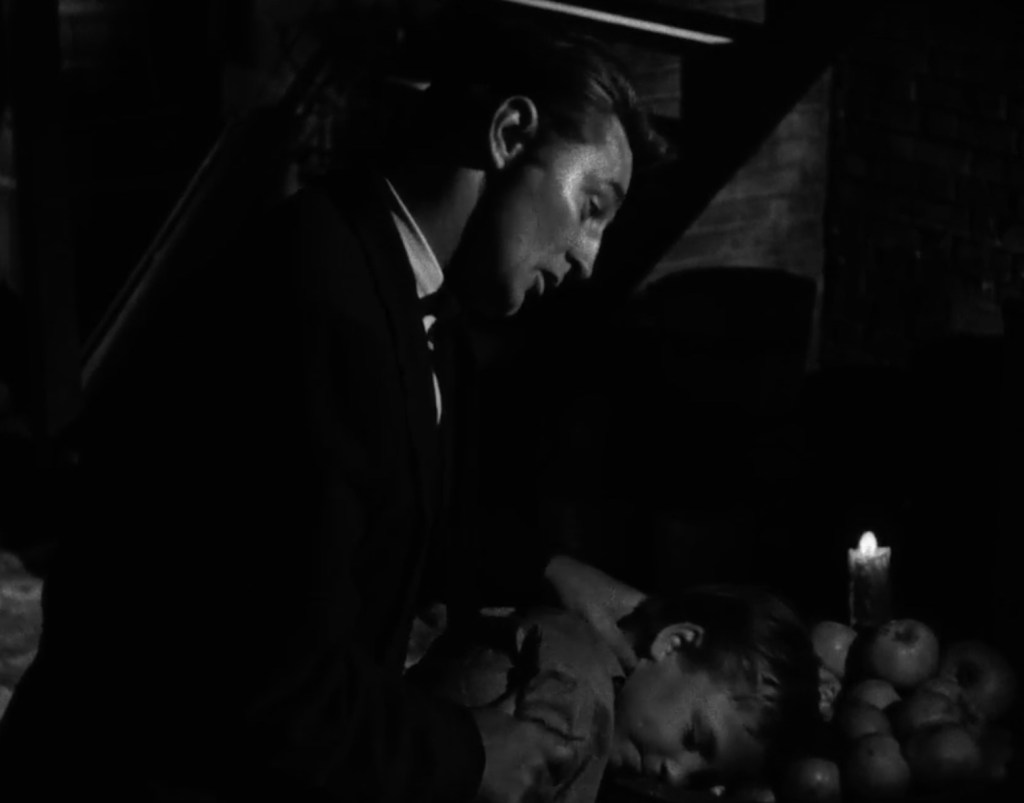
He even threatens to kill John with a knife. Just as he uncovers where the money has been hidden, young John manages to knock out the vicious preacher and escape with Pearl after locking Powell in the basement. This scene is an obvious allusion to the tale of Hansel and Gretel, where the two young siblings, a brother and sister, escape from the clutches of an evil cannibalistic witch. The above scene described in the film is one of the most frightening scenes for its time. In fact, it is one of the most frightening scenes of all time.
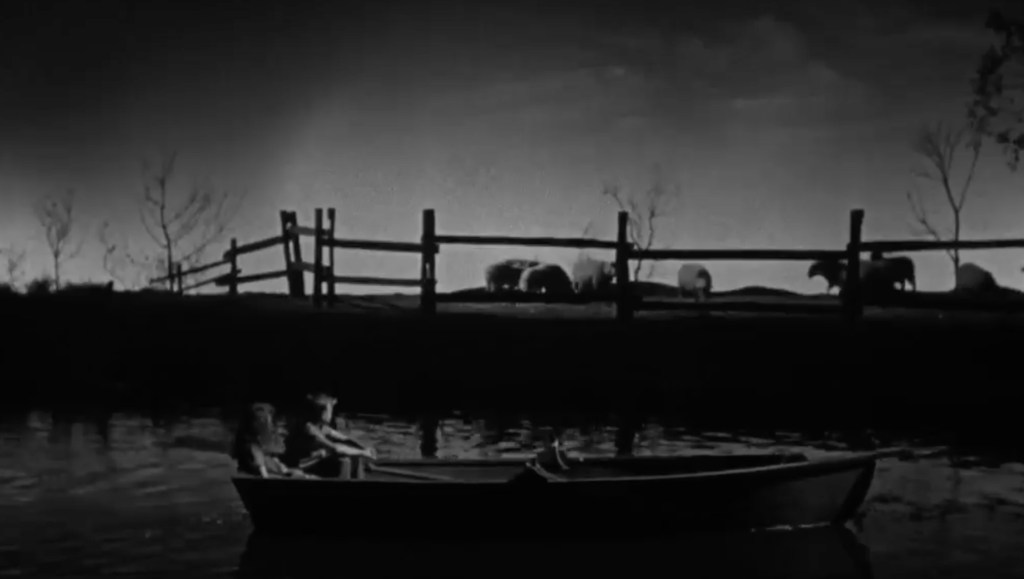
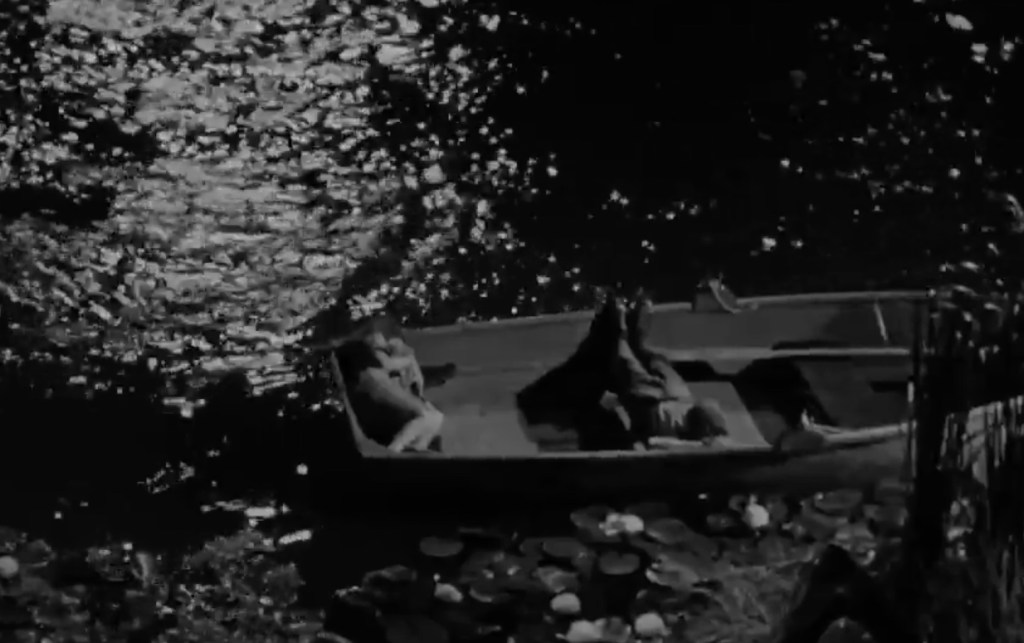
Brandishing a knife, the reverend pursues the children, who escape with a rowboat on the very river that runs across their town. What follows is a beautiful extended scene with visuals of birds, frogs, rabbits, and other fauna in the backdrop as John steers the boat across the river. One of the most heartbreaking scenes in the movie is images of the boat when an innocent Pearl sings a nursery rhyme, and an exhausted John lies near her.
The Preacher is not done and is hot on the trail of the children. There is one chilling scene where the children are hiding in a barn, and John sees the dark shadow of a man on a horse, obviously Powell, pass them. Charles Laughton uses many elements of German Expressionism in these parts of the film.
Ultimately, John and Pearl run into a middle-aged lady we saw in the opening scene. She initially spanks John for trespassing but then feels sorry for him and Pearl and takes them home. The lady is revealed to be Rachel Cooper (Lillian Gish), a kind-hearted, strong, and religious soul who cares for destitute children.
Rachel tries to interrogate John, who is not the least bit forthcoming about his or Pearl’s identity. John is obviously worried about being sent back to the notorious preacher. Rachel, a devoted Christian, compares John and Pearl’s journey across the river and being discovered by her to that of baby Moses
across the Nile and being discovered by the Egyptian Queen.
The Preacher soon finds out where the kids are hiding. He approaches Rachel’s house. Is Rachel able to save the kids from the clutches of the vicious homicidal preacher? That question is answered by the rest of the plot. Until this part, the plot is terrifying and riveting.
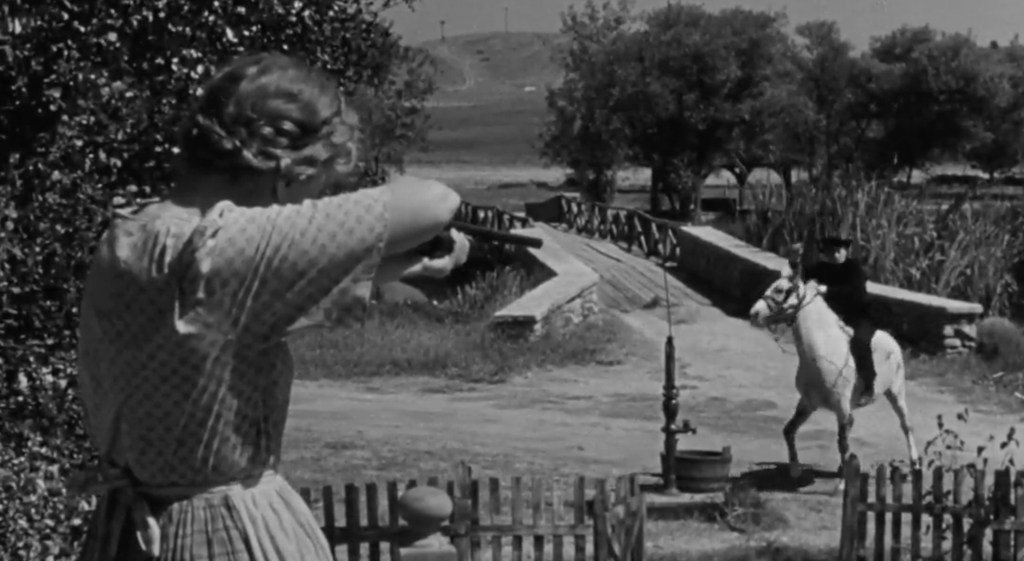
Unfortunately, at this stage, as the story approaches its climax, I felt that Laughton dropped the ball. The standoff between Powell and Rachel, while intense at the beginning, is not very convincing. How a woman with a shotgun, strong as she is, could intimidate a relentless and brazen criminal like Powell is simply beyond me.
Another slip-up in the plot is that when Rachel forces Powell to leave, the latter actually tips her off by warning her that he will be back at nightfall to get the kids. It would have been more plausible that Rachel, the great judge of character that she is portrayed to be, intuitively deduces that the fiend would return under the cover of night.
While parts of the nocturnal standoff are tense, the climax is extremely flimsy and tame compared to the rest of the fast-paced plot. The ending left me unsatisfied and feeling let down.
Having said that, the performances of all the lead thespians, the direction, screenplay, dialog, and cinematography are all the positive aspects of this film and still make it a masterpiece. This is a unique story in American cinema, and there has been none like it.
The narrative and cinematography, and incorporation of fairy tales and poetry and scripture along with German Expressionism are all ingenious. Laughton is indeed a master storyteller.
There is also some dark humor in its plot. The initial scene where Powell has a one-sided conversation with his God, asking for a Widow and then thanking him for all that was given to him so far, was morbidly funny. Another memorable moment is where Powell is waiting in the dark for an opportunity to enter Rachel’s home to get to John and Pearl. He suddenly starts singing a religious hymn, and unexpectedly, Rachel, who is guarding the children from him, shotgun in hand, also joins in the singing.
It is unfortunate that this movie bombed on release and would affect Laughton so badly that he would never direct another movie again. “Night of the Hunter” is his rise and fall. Upon release, the movie drew criticism from many religious organizations for its negative portrayal of a holy man.
However, over the decades, the movie has drawn enormous fanfare and is considered one of the greatest movies ever made. Robert Mitchum carries most of the movie with his strong and powerful performance of the homicidal God man. At one moment, he can be charming, and almost instantaneously, he can also be deliciously evil. Shirley Winters puts in a good performance as his helpless victimized wife, Willa.
Lillian Gish also puts in a great performance as Rachel Cooper, a woman of strong faith and character, with immense kindness and fearlessness to stand up to the most vicious of men.
“Night of the Hunter” will be considered a masterpiece in filmmaking in years to come. The theme of the evil maniac pretending to be a man of God appears like an ominous prophecy that comes from far more innocent times. All in all, this is not a movie to be missed.
References
https://www.criterion.com/current/posts/909-the-night-of-the-hunter











 Bay Area Bloke