

Having made allusions to the greatness of the Malayalam/Kerala film industry in my earlier posts, it is high time I reviewed a Malayalam movie. I am more than delighted that “Munnariyippu” (The Warning) will be the first Malayalam movie I review.
I stated earlier that Kerala’s Malayalam film industry and the Bengali movie industry are known for consistently delivering high-quality movies. Unlike many other Indian film industries like Bollywood, Kollywood, Tollywood, or even Sandalwood, neither Malayalam nor Bengali movies are made with large budgets.
It is the passion of the moviemakers, the technicians, and actors that helps them create such fine works of art. Another factor that contributes to this kind of moviemaking is a demanding literate audience that expects more from their movies.
“Munnariyippu” is undoubtedly one such gem, hailed by audiences and critics for its plot and its thespians. Mammootty, the protagonist in this movie, is a star of Malayalam cinema with a gigantic fan base. Unlike many ‘stars’ of Indian cinema, who choose only to be in large-budget movies with larger-than-life heroic roles, Mammootty often challenges his own acting potential by taking on unconventional, unique roles, like the one in this movie. This is true for quite a few Malayalam actors, men, and women, who refuse to be carried away by their ‘star’ images.
Ok, enough said, let’s get on with the plot. The movie begins with a young ambitious freelance journalist, Anjali Arakkal (Aparna Gopinath), trying to establish herself by driving to a party hosted by KK, a well-known and revered journalist.
Pratap Pothan, in a brilliant supporting role as KK, a self-centered, egotistical individual, loudly berates his chef and then proclaims to his adulating audience how the right blend of ‘spice’ creates fine dishes and great writing. Suddenly, to Anjali’s astonishment, he singles her out from the crowd, beckons her, and asks her if she is interested in ghostwriting for a jail superintendent, Rama Murthy, who is interested in telling his autobiography.
With limited prospects for her career at that time, Anjali agrees and meets Rama at the Central jail. As Rama boasts about a scheme he implemented in the prison that helps convicts find work, Anjali is distracted by the demeanor of one of the felons who serves coffee.
The jailer introduces him to Anjali as Raghavan, a convicted murderer of two women and now a 20-year resident at the jail. Raghavan was found guilty of the murder of his wife and another girl belonging to a family he worked for.
Raghavan appears as a paradox to Anjali. He is subservient and soft-spoken, with none of the attributes one would associate with someone in his predicament. However, as he serves the coffee, he strongly, but quietly, asserts to Anjali that he did not murder anyone.
Intrigued by Raghavan, Anjali convinces the jailer to allow her to interview Raghavan one-on-one in jail. Raghavan’s handler in jail informs her that Raghavan has never had a single visitor in all his years in prison.
Further, despite having served a sentence for 14 years, Raghavan prefers the comfort of the confines of a prison to the freedom outside its walls. When she finally interviews Raghavan, she is even more impressed that Raghavan is a philosopher with acute wisdom who can make profound dictums.
For instance, when asked why he did not want a new life outside of prison, Raghavan tells Anjali that we only have one life, and asking for a second life did not make sense to him. His comparison of the truth to light, that can never be extinguished but always present, also has an impact on Anjali.
Raghavan’s handler tells Anjali that Raghavan writes his musings in a notebook. With Raghavan’s permission, Anjali acquires the notebook and shares it with an editor.
The editor is blown away by Raghavan’s profound wisdom, and he asks Anjali to write an article on Raghavan, claiming that for her, this is a chance of a lifetime. Anjali follows through, interviews Raghavan’s former attorney, a member of the family of the woman Raghavan allegedly murdered, completes the article, and has it published. Soon, the article, Raghavan, and Anjali gain fame and popularity.
With mounting public outcry, the superintendent, jealous of Raghavan’s mounting fame, decides to release Raghavan. At this time, Anjali is approached by a book publisher and asked to write a book on Raghavan.
There are a few stipulations from the publisher, one being that the book should be completed within the deadline. Another is that the book should not be about Raghavan’s philosophy but should narrate his story. Anjali agrees, and when Raghavan is released, she becomes Raghavan’s sponsor.
She provides accommodation for Raghavan in a small apartment, obscured from prying public and competitive journalists. She provides Raghavan with stationery to tell his story in his own words in Malayalam, so that she can transcribe it into her English book.
Over the next few months, Raghavan slowly adjusts to his surroundings and befriends a young boy. Unfortunately, to Anjali’s growing frustration and mounting pressure, R
aghavan cannot bring himself to write a single word.
On one occasion, he steps out and gets recognized by a man who has read Anjali’s article. Upon the man’s insistence, he accompanies the latter to a bar and is soon seated at a table having drinks with the man and his friends.
In an inebriated state, Raghavan reveals to the group and the viewers his own philosophy of what it means to be free. His words would give powerful revelations to the plot.
Anjali is in a state of ceaseless pressure from the publisher to complete the book, the jailer to complete his autobiography. Her professional contacts are increasingly disappointed with her lack of professionalism in not delivering what she promised. Can Anjali convince Raghavan to tell her and the world the real truth? I will not say more about the movie, and strongly encourage my readers not to miss this movie masterpiece.
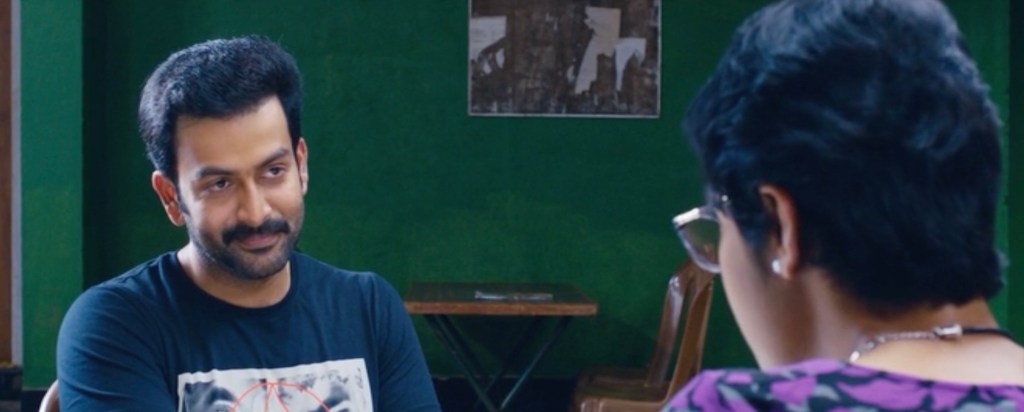
Many critics have rightly pointed out that “Munnariyippu” is more than a psychological thriller. It is a masterpiece in storytelling with mesmerizing performances from Mammootty, Aparna, and the rest of the cast, which also includes a cameo from Prithviraj Sukumaran. As one critic pointed out, it is also a character study of a unique individual. The movie has a breathtaking sense of realism, and Mammootty’s performance as Raghavan is supremely convincing. Little wonder that Film Companion rated his performance among the top 100 performances of the decade.
One aspect of the movie I liked was that a director could easily be tempted to throw in violence and blood at the end of the movie for impact, but the director of the movie, Venu, decided that the climax by itself would suffice. He was right.
Please be forewarned that this is a slow burner. It is also an intense and deep movie. But do stick with it to ensure that you do not miss out on a memorable performance. This movie is a must-see for all critics and lovers of cinema.




References:

 Bay Area Bloke