
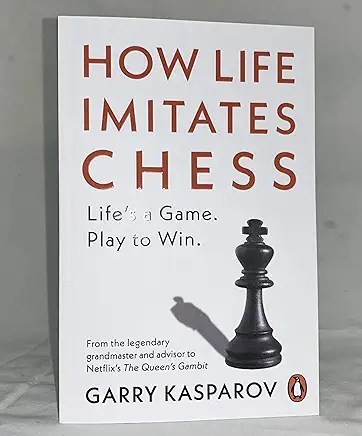
Kasparov became the youngest Chess champion at 22. Today after quitting Chess, he is a politician. He presents what he calls the lessons he has learnt from the world’s ‘greatest game’.
Chess is ideal for decision making as it involves quick decisions amid pressure from your opponent. It requires calculation, creativity and a desire to win. There is also memorization, precise calculation and logic.
Success comes from a synthesis of all of the above where the whole is greater than the sum of the parts. A CEO must combine analysis and creativity to come up with solutions to her problems. Unlike the real world, your moves on a chessboard are limited, but it still provides a model for decision making.
The key is to seek out and find your path. As a child, Gary listened to tales of voyages. In chess, Gary decided to seek out territories no one had seen before. To traverse our path, we need a map. A map informs us about the known and the uncharted territories of our minds, our strengths and weaknesses and the unknown. We must find our own.
Anyone can learn the rules of chess. We must dig deeper learning to recognize patterns and their inherent logic. With time, knowledge, talent and experience all come together. This triumvirate becomes our ever improving intuition and blends with our psychology and then becomes our style. Our style is our individuality
What are our strengths? Weaknesses and what challenges do we seek and why? These are questions that we must ask ourselves.
“Better decision making cannot be taught, but they can be self-taught” .
Be conscious of your decision making methodology. This is vital for us to correct our maladies and improve what we do well.
We must see the big picture and deal with crisis in our lives. We must be able to make effective choices when we meet a fork in the road. The way to do this is to seek out challenges, and exploit our gifts.
For this we need to develop our blue prints and have the ability to trust our instincts and realize that we are stronger despite any external results.
The Lesson
Kasperov was faced with elimination in 1984 when he was up against a champion, Karpov. He decided to prepare for a long war, rather than giving in to desperation. Switching to Guerilla warfare, he took fewer risks.
Karpov changed his strategy to make a clean sweep, a plan that went south. Kasperov learnt of Karpov’s thinking strategy and his own. However, he lost the next game and was one game away from elimination.
Kasperov won the next and kept going. In the fifth month of the series, Kasperov won game 47. He won the next game and in 1985, the match was postponed for 5 months. Kasperov said that the world champion had been his personal coach. He also understood his own play. When the match resumed, Kasperov won his first game and was now a veteran and went on to become the champion for the next 15 years.
The marathon with Karpov taught Kasperov valuable lessons. Talent and hard work are inadequate. One must develop self-awareness to operate at your peak. Life like chess is neither a trivial pursuit nor an exercise left only to geniuses. At the heart of the game is strategy
Strategy
If you knew all the rule of chess without knowing a checkmate, you would know tactics but will not have a strategy. Strategy is based on long term goals. Tactics are more concrete and based on immediacy.
Sun Tsu said that strategy without tactics is the slowest rout to victory. Tactics without strategy is the noise before defeat. Playing without long term goals makes your play reactive and soon you’ll be playing your opponent’s game. The 1992 election saw Clinton attacked with a series of scandals. His strategists responded to each of them but also had a message of their own. The strategist looks to a favorable outcome in the distant future and makes effective moves for them now. Asking ‘Why’ turns’ tactics into strategy. It separates visionaries from functionaries. Every move has a consequence.
Tactics involve speed, but are almost trivial compared to strategy. They are forced responses, if then statements. They can become complex and error prone if they are many. For every move you need to see you opponent’s response. At any great opportunity, you must be able to throw tactics away and seize the given opportunity.
Play your own game
Know your strengths and weaknesses, but use your own style. This strategy helps one adapt. Different individuals have their own style. Even when Kasparov is on the defensive, he looks for an opening to attack, his real strength and while on the offensive, looks for a better way to attack.
You cannot always predict your battlefield. This is where your adaptability comes in. It does not pay to be a laager or a leader in planning your tactics. Britannica Encyclopedia made a tactical error in delaying their move to CD Rom media. The dotcom era is an example of many who tried to go on hunches about unpredictable markets.
Sometimes loosing can force you to change a good strategy while small victories could make you blind to potential disasters. Only a major shift in the landscape should force one to reevaluate her fundamentals. We must walk the fine line between flexibility and consistency.
Sometimes your personal style may be at odds to the strategy needed to win. This is when you must change your strategy. This is where the power of why comes in. Avoid change for the sake of change.
Do not watch the competition more than you watch yourself. The competition can trick you away from a working strategy with diversionary tactic. Chess between two people can be a zero sum game but in a tournament, happenings in other tables could affect you.
There is a balance between knowing what your competition is up to and to be aware of things within your control.
Once you have your strategy on paper, we stay on track with rigorous questions of our results. With each success, changing becomes even harder. Sometimes, the teacher must learn from the students. Believe in your plans but ensure your plans are worthy of your beliefs. This takes constant practice. Strong tactics need strong strategy and great calculation. Both need a look into the future.
Strategy and Tactics together
“Tactics is knowing what to do when there is something to do. Strategy is knowing what to do when there is nothing to do” There are times to wait. These are called positional plays in chess. It is important that one takes small steps in such cases but never stops thinking. Many times this may be at many points. In life, there is no real urgency in such situations and one is likely to develop unhealthy habits like TV or business as usual.
Element of Surprise
Sometimes your opponent may read your moves. In such cases, change your game. This will lay to waste your opponent’s planning.
A genius for Development: -You must have a well developed position before going for attack. Morphi, the first American Chess hero used this strategy.
Sticking with a plan:
With the growth of modern technology, chess moves can be dissected and analyzed almost instantaneously. This makes it hard to have the element of surprise. In a game of rapid chess, many are likely to abandon their guiding strategy. Experience has showed Kasparov that the most successful players stick to a plan. Trusting yourself means sticking to your plan and trusting your instinct.
Confidence and the Time Factor
When we postpone decisions because of uncertainty we often give into the vicious cycle of anxiety and time pressure. The enemy of the strategist is the clock. It forces us to make emotional moves. Intuition can fail one in such cases. The best plans devious tactics can fail in the absence of confidence.
Churchill said that courage was the most important of the human qualities, as it guarantees all others.
Your next Move
It is impossible to predict how many moves ahead one sees in advance. The possibilities are too numerous to reduce chess to arithmetic. As one looks at counter moves, the branches of the decision tree grow exponentially.
The further ahead one looks, the more likely he is to miscalculate. An elite player does not see much further ahead than most good players. A computer sees much further ahead, but cannot judge the best move possible. This is where computers falter.
When Kasparov starts off, he does not see a decision tree but all the objectives like king safety and material strategy. This lets him plan intermediate steps and only when the smaller objectives are met can he focus on the larger goal. Switching moves abruptly can cause confusion and is an undue risk. You must also know when to stop.
Imagination, Calculation and His First game
You must be aware of trends and patterns in your analysis. Sometimes imagination can help compensate for a lack of deduction. One can foresee many moves in advance in her imagination.
Talent
Talent is the least understood of human advantages. Even the most extraordinary talents need the opportunities to develop. Kasparov’s father recognized his son’s talents for chess. Chess came to Kasparov easily.
Patterns in our lives
Talents are attributes not switches. To excel in chess, one needs innate talent and acquired knowledge Memory and Fantasy.). Some have great memories, but it is a myth that chess players have great memories. They have what Kasparov calls ‘Chess memory’. A chess player does not recall all calculations from scratch. They find parallels and apply their knowledge of analogous positions.
To solve a problem they do not start from scratch. They look to a past pattern. Traders see trends in stock movement. Parents see behavior in their children’s behavior. Experience and memory blend this together. Review your performance at the end of each day. What lessons can you take away into tomorrow? Push the boundaries and widen the angles of your lens of the world. Dream big!
It is hard for a human to be objective. Fantasy can cut through fog. Sometimes calculation alone cannot sort problems.
The habit of Imagination
Imagination helps being innovative all the time. Thinking outside the box can come as a surprise to your opponent.
“Fantasy must be backed up by sober evaluation and calculation. Otherwise you end up making beautiful blunders.”
“Too often we often brush off outlandish ideas and solutions.
Failing to think creatively is as much self-imposed as it is imposed by the parameters of our jobs and our lives… What if often leads to why not.”
The more you experiment, the more chances you will have for success.”
Preparation
“Talent undiscovered may as well not exist.”
“Why is the capacity for hard work not considered an innate gift?” Michael Jordan was the first to arrive at practice and the last to leave.
Results are what matter.
In addition to preparation, Kasparov credits the discipline instilled on him by his parents and coaches. Kasparov admits that he was one of the premier users of machine analysis and databases to improve his game. He focused on results and claims his methods may not work for everyone.
While others criticize your winning ways, you must be careful to see if you are getting your just dues.
Preparation pays. It is the quality of your study, consistency and self awareness. Kasparov goes on to say that though he did not use most of his prepared tactics, there was always a positive correlation between his hard work and his results. “Work leads to knowledge and knowledge never is wasted.”
Look for ways to experiment and push the boundaries in your endeavor
The game and the science
Kasparov had a strict regimen of diet, study and rest, thanks to one of his teachers and his mother. He stays conscious of how his time is spent. He loves his afternoon nap. Know what motivates you and figure out how to push yourself.
Use competition, goals and the like to motivate you. “There are guidelines for what works, but each person must discover what works for him.”
Besides knowing what to look for, one most evaluate all factors pertaining to the situation.
MTQ(Material, Time and Quality) Chess is an art of balancing all three of these factors. One has to make make trade offs between available resources, time and quality. Decision making is error prone but gets better with active thoughts. Become aware of poor choices and move beyond them.
All decisions improve with a better process. One thinks strategically with MTQ). Usually beginners tend to gobble up their opponent’s material. One must know the actual value of the material one gathers. This is not easy. Your emotions(prejudices and preferences) about some material can cloud their actual value from you.
Time is money. You are payed labor for your time. You have only so much time to make a move or complete a series of moves to meet a certain objective. One must use both these concepts of time to his advantage.
The one who makes the first move acts, while the other reacts. Moving quickly and cutting corners does not always buy time. The champions know to make tradeoffs between time and material. When attacking time is more important than material. One must be careful not to go after material gain when it affects a winning strategy. Kasparov usually chooses dynamic factors over static factors.
Quality: Each of your material processions have an intrinsic value. They can tell who is ahead at a point in time. At different times materials fluctuate in value. The strategist seeks placement of his resources. A piece can loose its value. In such cases, you can trade it for another piece you increase your footing. Note that this is not true in some cases like in stocks.
The concept of Never: A piece that has been trapped has lost its value.
Double Edged Evaluation:
Count the resources first and then look at placement and territory. (Reminiscent of ‘Art of War’). Structure is a double edge sword. It comes into effect when you are evenly matched. This is where one must detect the minutia. The devil is in the details.
Personal Return on Investment;
For education, we invest time and quality to gain an advantage with skills and contacts. The questions we must ask are beyond trade offs. One may gain or loose it all.
MTQ at Home: We make MTQ tradeoffs while buying homes. Location, Location Location. Great players recognize the exceptions. The details are hard to remember and thus can be burdensome later. Balance, exchange and evaluate over and over. Use time for improving material. Quality is the promise of time and material well used.
Exchanges and Imbalances
When there is an imbalance of symmetry, we can it to our advantage. Most of us take our best guess and move forward, without consideration of all options. All elements combine to form a single big picture. The number of ways to consider all moves is only limited by our prejudices.
The search for compensation
Every move has positive and negative aspects. Material losses are the only negative losses though they may be beneficial in the long run.One must total the pluses and minuses to evaluate our position. We can turn material into time or vice versa.
In thermodynamics, energy is indestructible. It can only change form. In chess, we can grow stronger with more than one queen and so on. Firms can do this too.
All change comes at a cost. Coordination of resources becomes increasingly difficult with more assets. Kasparov uses the AOL-Time Warner merger example to illustrate this. Sometimes the combined power of many resources is greater than the sum of its parts.
When resources work together, they become more productive without loosing productivity. Sometimes, to meet a certain objective, one may add resources and hasten defeat. When in trouble one must never gamble on a risky venture or in overextending herself.
While risk taking is essential in every field, what is critical is the context of that risk. In Norman Mailer’s words, we are either living a little more or dying a little. There is simply no standing still.
Phases of the game
We can know only where we are going by knowing where we are. Kasparov stresses on grounding in the present. Chess can be broken into three phases, opening, the middle and end games.
In the first phase the battle lines are drawn. It is the hardest part of the game. One must determine the ‘opening’ in this part or the one move that predetermines the next set of moves. An opening that worked for an expert may not work for you. Memorization of moves is often useless in a competitive situation. If you follow an expert’s move, know the motive behind the move. Memorization always inhibits your evolution as a player. Opening sets the stage for the type of middle game you want.
Creativity on opening is best cultivated at home rather than at showtime. This is the only opportunity for creativity.
“Try out new ideas in your own creative space.”
Surprise is hard to pull off but extremely effective.
Art is the offspring of creative conflict. The opening creates the launching pad. The takeoff happens in the middle game. Be open to new happenings all the time. Your previous strategy may not work now. Formulate a new plan.
SWOT stands for strengths, weaknesses, opportunity and threats. You must be open to new moves or adjust to your new threats. The middle game is the most open to art. “Disaster lurks at every corner.” This is the time when action is rewarded. It needs quick thinking. One must find similarities to the past, what worked then and what failed then.
In the middle game, after an organization has launched its product, it must focus on advertising and pricing. It must improve on the foundation built in the previous stage, the opening. This is why one must study the whole game, not just the opening.
“A good peace follows a good war.” The end game begins when the potential of the players is gone and only a few survivors still prevail. The plans and possibilities are known and usually goes predictable.
However the fallibility of human nature still leaves room for more moves. Sometimes a wrong move in the end game can cause a tragic consequence. The end game and its lack of action leads to ennui and thus open to error. Instincts often cause creativity to diminish. Existing problems must now be seen with fresh eyes.
Eliminating Phase Bias: There is always room for improvement. Find out your strengths: Preparation, fluid action …? You must find the weaknesses and eliminate them from your game.
“Do not bring a knife to a gunfight.” What worked in the middle game may not work in the end game. Do not under estimate dynamic factors. A smart player takes all three factors into account. The transitions between them must be smooth.
The attacker’s advantage
“Even a bullet fears the brave” – Russian saying.
Recognizing known problems sometimes stifles creativity. With the mamouth decisions we are faced with daily, small improvements can lead to large payoffs. Decisions are often unpredictable. We must look at alternatives that can help us face challenges.
Sometimes if there is no immediate benefit to making an immediate decision, postpone it. Err on the side of your instinct and optimism. One way is to be proactive which puts the healthy pressure on you.
There is a double standard. A person who attacks is often considered aggressive and the bad guy. An attacking move by a CEO is aggressive but from an employee it is seen as assertive. Aggressiveness can be an asset.
We must ensure we are hard on ourselves, our environment and others. There is a controlled way of aggression that helps us improve. When you attack, your opponent’s moves become more reactive and thus more predictable. Maintaining threats and pressure enables one to hold the initiative.
Once you have taken this undertaking to attack, you must fuel it constantly. Either one must attack with one giant attack or squeeze slowly. If you attack in only one place, you become vulnerable when it is your turn to attack. One weakness alone is inadequate to cause defeat.
A threat can have payoffs even before fruition. “Buy the rumor, sell the news” is a Wall Street saying.
Sometimes some patience is better than an uncertain attack. While staying on the attack, one must avoid over thinking but with more controlled decision making.
“What you can do or think you can do, being it, for boldness has power and magic in it.” In war situations, defensiveness is almost obsolete today. “Static defense is dead”
- Only a leader can see around can see around the corner.
- While innovation is risky, not innovating is riskier and one must make a transition from imitator or innovator. The Japanese did this with American goods. The Koreans and Taiwanese are doing the same to Japanese
The Will to Attack.
- All skills and preparations are useless without the gut to attack. Be prepared to strike first. The first strike is more artistry and guesswork than skill. There is no indicator for the time to attack. At this time, one must ignore assumptions, underestimation and overestimation of the opponent.
- It is worse to ignore an opportunity than to make a bad move.
Question Success
- Success is often an enemy of future success. Satisfaction can destroy vision of the future.
- Winning deludes one that things are going well. We do not ponder when we win.
- We must train to do better even when we win.
Competition and Complacency
- Constant reinvention is a must in all industry.
- Playing your own best game without regard to your opponent’s strategy can be disastrous.
- We perform our best in the midst of competition.
- Seek out the best competition for you.
- Benchmarks are essential for us to maintain our high standards.
- Nurture your inherent advantages but be open to new techniques.
- “Before you can fight, you must know what you are fighting for.”
In favor of Contradiction
- No one enjoys being contradicted. A leader who is open to success can achieve dramatic success.
- You learn more from losses from better opponents than from any results gained from opponents who play at your level.
- “You must find the balance between competition and correction”
- “Loose as much as you can take it.”
- Invite criticism and evaluate your techniques. They could lead to dramatic improvements in your game.
The inner game
- Results can sometimes be a foregone conclusion.
- Getting back on your feet after a devastation is not easy. However, the successful come back with renewed wisdom and motivation.
- Winning requires a strong psychology.
- Nervous energy can be ammunition before a battle.
- Creative energy can be felt even by your opponent.
- Mental muscles wear out from lack of use. It is time to worry when things seem too easy for a while.
- Defeat can also lead to more defeat. The metal game is at work here again.
- It makes no sense in believing that failure now will lead to success later.
- We must focus on results and sometimes abandon our blind beliefs.
- Question your approach and abandon your ego when necessary.
- Only in an ideal world will you get what you are entitled to. When you belive you are entitled to get something you may be closer to loosing it.
- Results come down to the best moves and decisions.
- Decision build on our personality.
- The inner game is the game.
Man vs. Machine
- Machines are free of prejudices and preconceptions.
- Computers make linear decisions and do not ‘think’ long term. This was true until Deeper Blue defeated Kasparov.
- How it did so is a controversial subject Kasparov covers at length.
- In advanced chess, using a computer can be invaluable in analyzing a player’s mindset throughout the game.
- It is better to stretch ourselves out of our comfort zones. We grow when we nervously push ourselves beyond our presupposed limits.
- We may be able to get better at what we do by getting better at things we do not do.
- “Experience is not what happens to a man, but what a man does with what happens to him.”
- Intuition is a byproduct of our experience. Even the vaguest of hunches is based on knowledge from the past.
- Sometimes more time and more technology can diminish our intuitions. If you want to succeed, you must brave the risk of failure.
- Intuition tells us what, when and how.
- Intuition tells us when the law of diminishing returns begins to activate.
Spotting Trends
- Nobody knows for sure when a change is a trend and it is usually too late.
- It is worthwhile to look to the past to do trend spotting.
- What makes a trend new? What makes it different from the last time?
One Single Moment
- It is harder to find out if there is a problem than to solve a given problem.
- Knowing a solution is at hand is an advantage.
- In a multiple choice exam, the most intimidating answer is “None of the above”.
- Crisis and moments of conflict can create opportunities.
- In the midst of pressure, it is hardest to maintain it. the temptation to make a decision is strong.
End Game
- Kasparov resigned from playing Chess. He moved on to writing and politics, choosing to look for new challenges.
- The Kremlin is now closer to dictatorship, says Kasparov.
- He goes onto say that, if left unchecked, the regime could let Russia degenerate into a military state.
- On the other hand, if Putin’s regime disintegrates, it could lead to total chaos.
- WE HAVE TO BE WELL PREPARED, EVEN FOR VICTORY.

 Bay Area Bloke